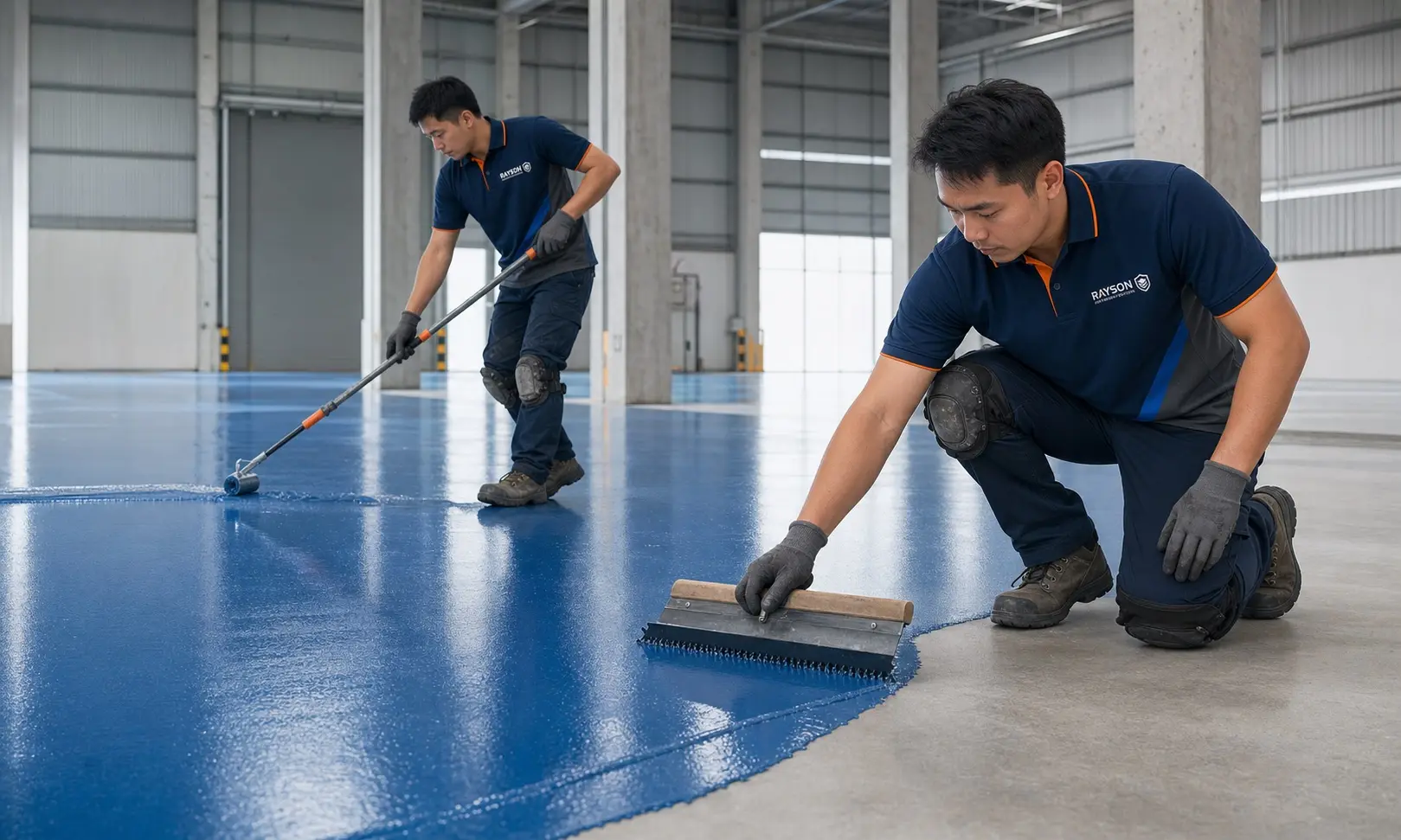
When an industrial floor coating fails, the instinct is to blame the product. In our experience it is almost never the resin. Modern epoxy and polyurethane systems are well understood and reliable — when they fail early, the cause traces back to one of five things, and every one of them is preventable. Here is what actually goes wrong, and how to stop it.
1. Moisture in the slab
This is the number one cause of coating failure in Singapore, and the most misunderstood. Ground-bearing slabs sit on damp soil in a humid climate; without an effective damp-proof membrane, water vapour moves continuously up through the concrete. Trap it under an impermeable coating and pressure builds until the coating blisters, then peels.
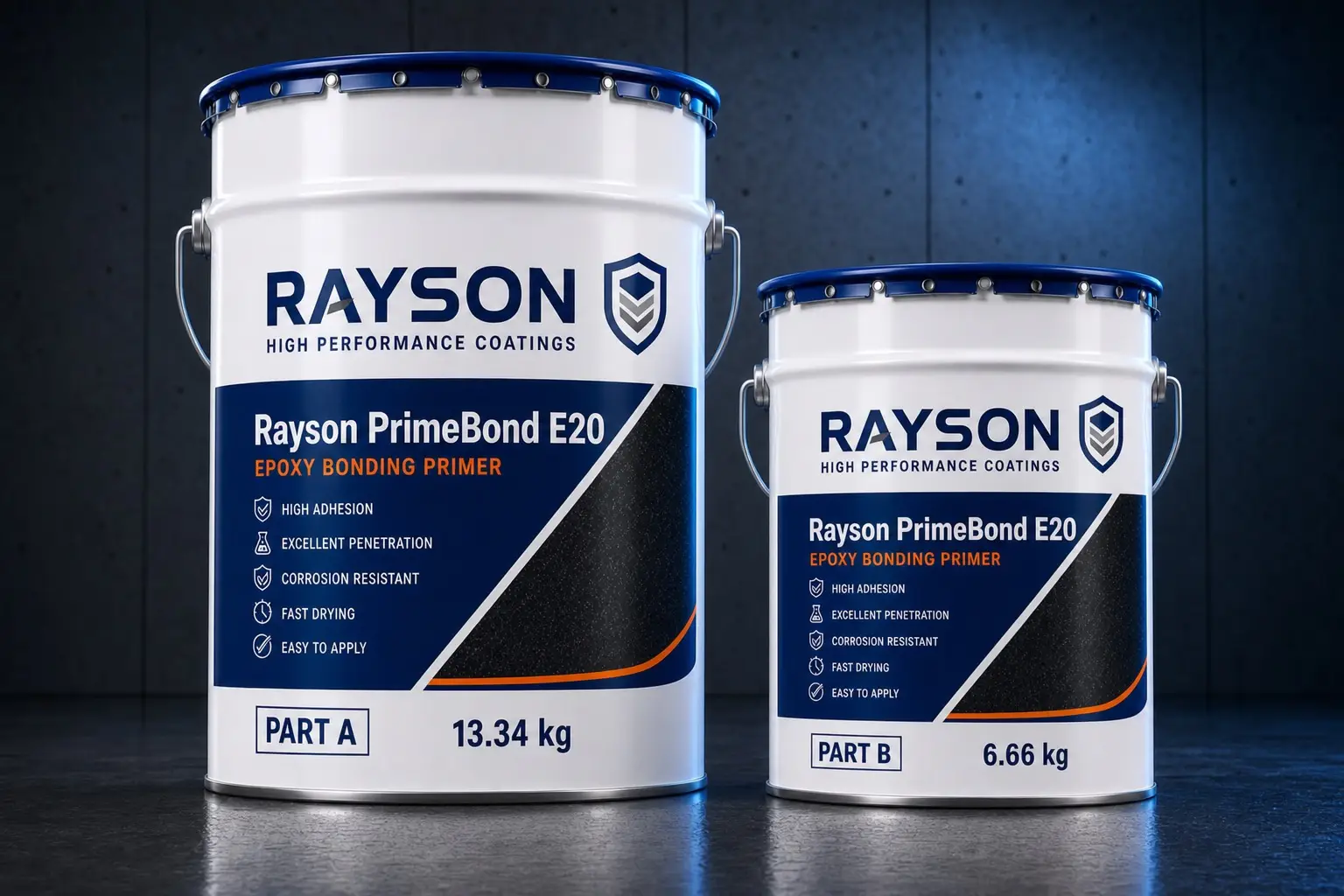
The fix is not a thicker coat of the same product. It is to measure the moisture before you coat — with relative-humidity probes or equivalent methods — and choose a system that suits the reading. Some primers tolerate damp substrates: Rayson PrimeBond E20 is formulated for dry or damp (not wet) concrete, which is exactly the situation on most Singapore slabs. What no primer tolerates is standing water or active ingress; those must be resolved structurally first.
2. Surface contamination
Concrete looks clean long after it has stopped being clean enough to coat. Two contaminants defeat adhesion silently:
- Oil and grease soak deep into concrete and wick back up through a fresh coating, destroying the bond from below. Areas saturated with oil sometimes have to be cut out entirely — degreasing the surface is not enough.
- Laitance — the weak, dusty layer of fine cement that rises to a finished slab — has almost no strength. Coat over it and the coating lifts, taking the laitance with it. It looks like sound concrete, which is why it fools people.
The defence is thorough cleaning followed by mechanical preparation that removes the weak top layer completely.
3. Inadequate mechanical preparation
Preparation is the single biggest factor in how long a coating lasts — more important than the product. Its job is to remove laitance and weak material, open the surface, and create a profile the coating keys into.
Acid etching, still occasionally proposed, is unreliable for industrial work: hard to control, leaves residues that must be fully neutralised, and does not remove contamination. Mechanical methods — diamond grinding for finer profiles, captive shot blasting for open textures under thicker systems — give a consistent, sound result. The profile must match the system: a thin roller coat and a self-levelling floor do not want the same texture.
Our full method is in the surface preparation guide. It is worth reading before any specification is finalised.
4. The wrong chemistry for the exposure
Even a perfectly installed floor fails if it was the wrong system. The classic mismatches we are asked to fix:
- Standard epoxy outdoors. Epoxies yellow and chalk under UV. Exposed decks need a UV-stable polyurethane finish.
- Ordinary epoxy under hot wash-down. Steam and hot water thermally shock a rigid epoxy until it debonds. Food and chemical floors need a PU-cement screed built for the heat.
- Smooth floors in wet areas. Not a durability failure but a safety one — rain and wash-down turn smooth coatings into slip hazards. Wet zones need anti-slip texture matched to the cleaning regime.
Choosing chemistry is a matching exercise against surface, traffic, chemicals, moisture and UV. The system selection guide walks through it.
5. Coating outside the recommended conditions
Resin systems are sensitive to temperature and humidity. Applied too cold, they cure slowly or not at all; too hot, and pot life collapses — mixed material can gel in the pail before it reaches the floor, especially in Singapore heat and in large batches. High humidity or a substrate near its dew point causes surface defects like amine bloom on epoxies.
Two disciplines prevent this: check conditions against the product data sheet before starting, and mix complete packs properly. Splitting a two-component pack by eye changes the ratio, and off-ratio material may never reach full properties. Mix mechanically, scrape the sides, and respect the pot life.
The pattern behind all five
Notice that four of the five causes are decided before the topcoat ever goes down: moisture, contamination, preparation and chemistry are all set at the assessment and specification stage. That is the real lesson — coating life is won or lost before the wearing coat is applied. Time spent on assessment and preparation is the cheapest insurance a floor gets; catching a problem then costs minutes, catching it after failure costs the whole floor.
Repair, when it is already failing
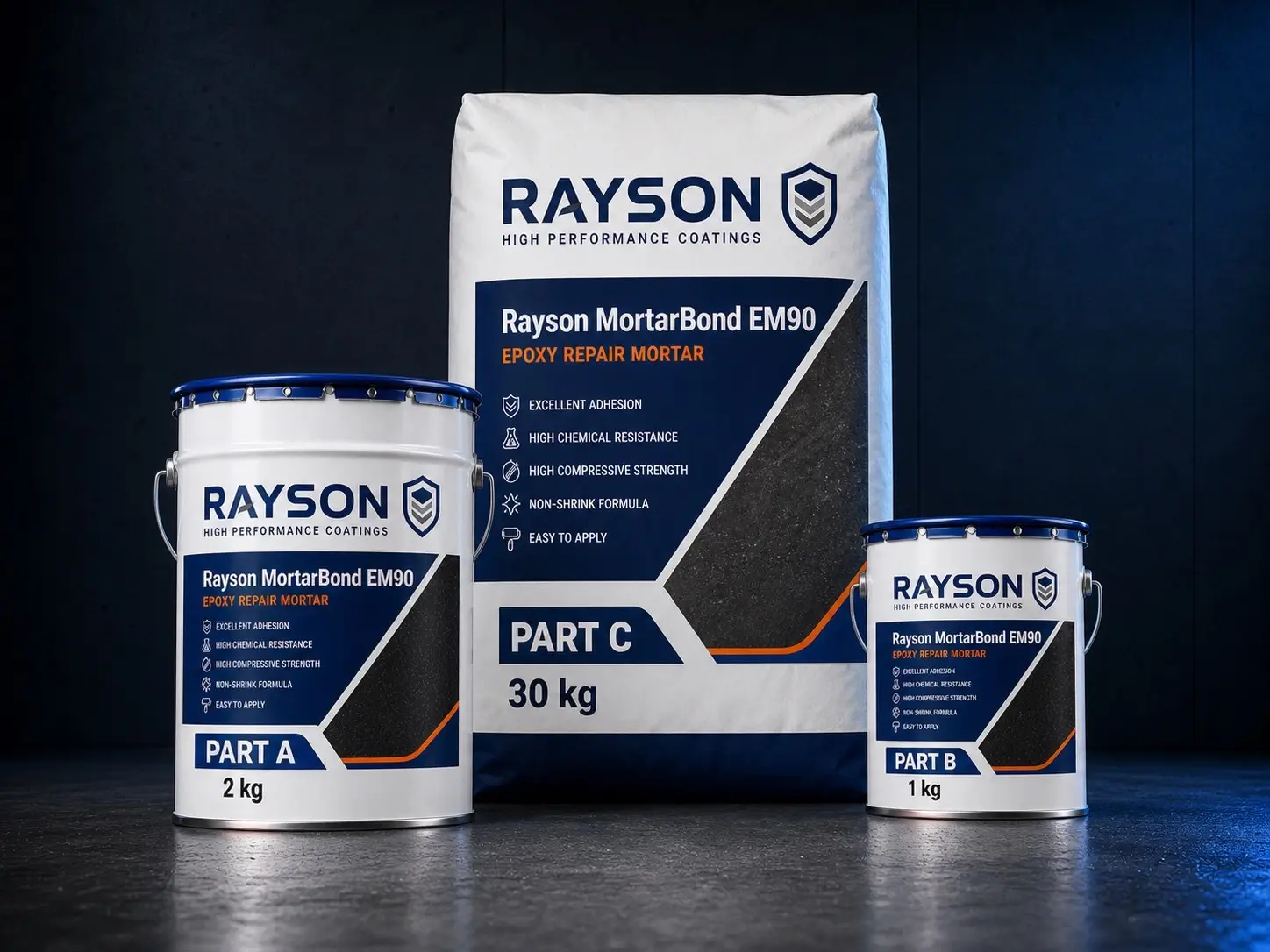
If a floor is already lifting, the honest first question is why. Localised impact damage over a sound system can be cut back to firm edges and reinstated with a compatible build-up — often using a repair mortar like Rayson MortarBond EM90 to reprofile before recoating. But if the coating is delaminating because of moisture or contamination underneath, patching only delays the spread; the substrate issue has to be addressed. An adhesion pull-off check and a moisture reading tell you which situation you are dealing with before you spend money on the wrong fix.
When you are unsure, send photos of the failure to our technical team — we would rather help you diagnose the real cause than sell a coat of paint over a problem that will come back.