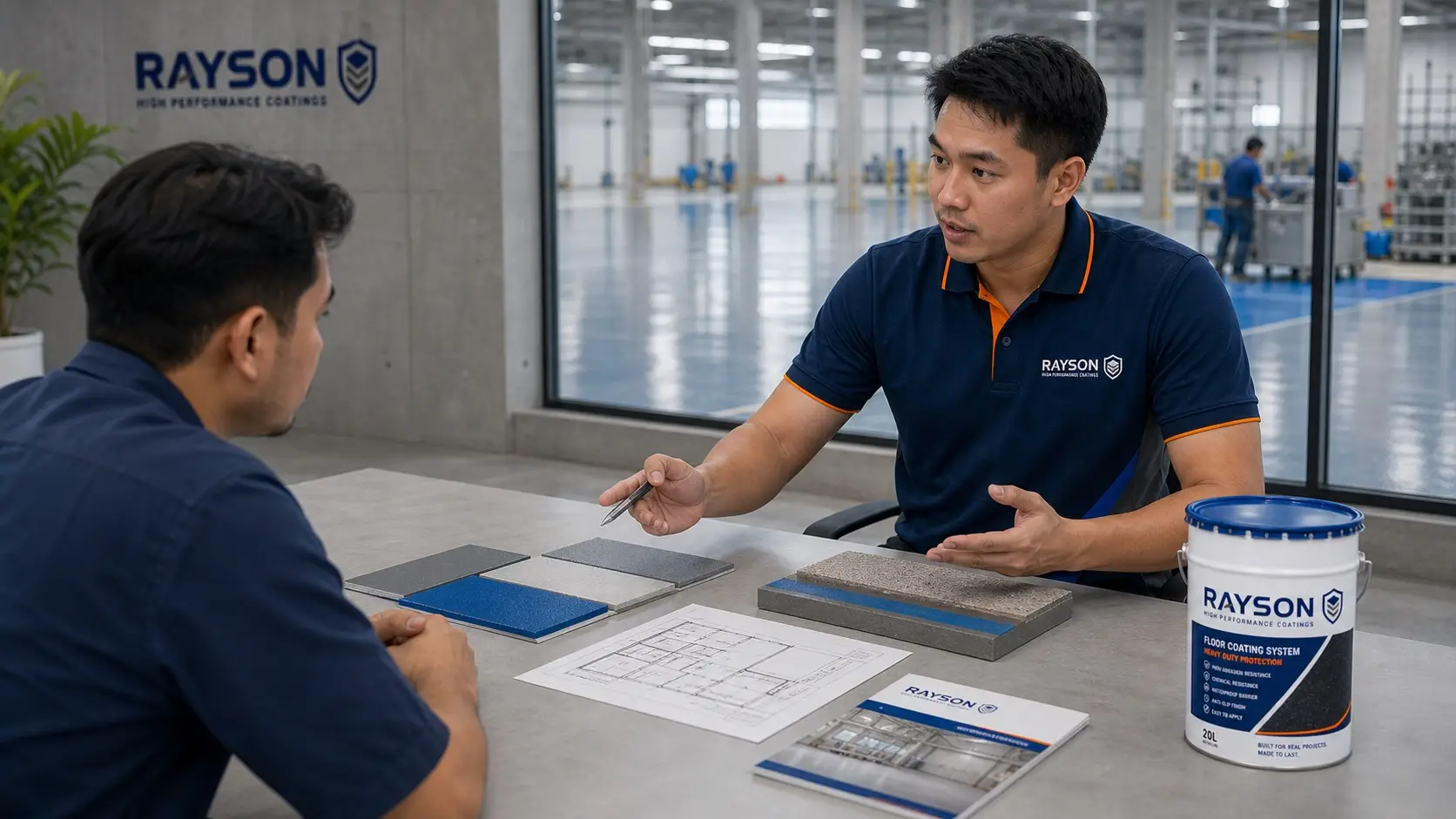
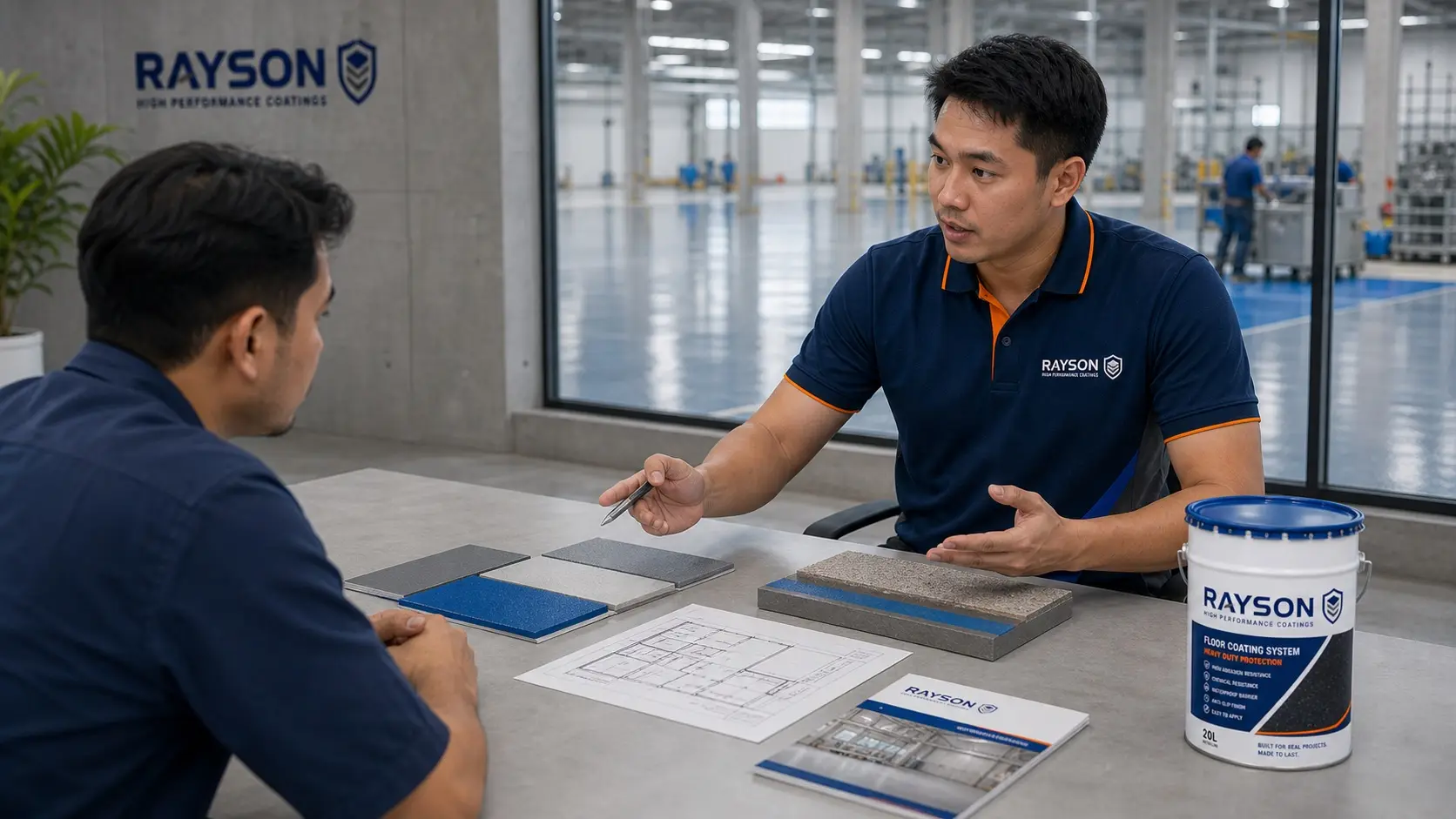
Every failed floor was once a confident quotation. By the time a coating is peeling, the preparation shortcuts, vague documentation and unreachable “technical support” that caused it are old history — which is why the time to qualify a supplier is before commitment, when the checks cost nothing but a meeting. Here are the seven that matter.
1. Technical data sheets — published, not promised
A serious supplier’s TDS library is open before you ask: per-product documents with real figures for mixing, coverage, application conditions, curing and — critically — limitations. Rayson publishes a TDS for every product, ungated, because that is what holding yourself to your own numbers looks like. A supplier whose data appears only on request, or whose sheets go vague exactly where the hard numbers belong, is preserving flexibility you will pay for later.
2. Safety data sheets on request
SDS availability is regulatory table stakes for chemical products. Ask for one early — not because you enjoy reading them, but because the response tells you whether the supplier controls its products and takes compliance seriously. Hesitation here predicts hesitation everywhere.
3. Technical support that survives hard questions
Ask something real: What substrate moisture will this tolerate, and how do you test for it? What happens if the recoat window is missed? What is this system not suitable for? A manufacturer-grade answer is specific and sometimes says “no”. A sales-grade answer is enthusiastic and says “no problem”. The floor will eventually grade the answer for you — cheaper to grade it in the meeting.
4. Batch consistency and traceability
The sample you approve and the pails that arrive months later must be the same product. Ask how batches are recorded and traced, and what happens if a batch is questioned. Suppliers who manufacture — or who work closely with their manufacturer — answer easily. Box-shifters change the subject.
5. Honest lead times and stock
“Ex-stock” is easy to say. Ask what is actually held locally, what comes to order, and the honest lead time for your quantities — then watch whether the delivery story stays consistent between the sales call and the contract. Programmes fail on fantasy lead times as often as on bad product.
6. A system, not a shelf
Floors are built as systems — primer, body, finish — and the compatibility between layers is engineered. A supplier who can stand behind the whole build-up from one range gives you a single owner for intercoat adhesion, recoat windows and chemistry. If layers come from different brands, someone must own compatibility explicitly, in writing, or nobody owns it at all.
7. Documentation that admits limitations
Read any supplier’s literature for the word not — as in “not suitable for”, “must not be applied when”. Honest documentation names its limits, because every real product has them. Literature with no limitations is not describing a perfect product; it is describing nothing.
The two fastest red flags
- A per-square-metre price quoted sight-unseen. Substrate condition, preparation and repair dominate real flooring costs; a price that ignores them is designed to change after commitment.
- “Resistant to all chemicals.” Chemical resistance is always specific — to the substance, concentration, temperature and contact time. A universal claim is a universal admission that nobody checked.
Qualify once, properly, and the rest of the project inherits the honesty you insisted on at the start. For who you are actually buying from when you buy “flooring”, see coating manufacturer vs distributor vs applicator.